Police Clearance Dress Code: What to Wear for Your Photo
The police clearance dress code is short and easy to follow. Wear a clean top with sleeves, long pants or a skirt of modest length, and closed shoes, and save tank tops, shorts and slippers for another day. Staff take your picture on the spot, and it ends up printed on the clearance itself, so your outfit counts for more than you might expect.
Dress rules checked on 29 October 2026. Every station keeps its own house rules, so a notice at the gate outranks anything written here.
A quick note first: this site is independent, and nothing on it speaks for the PNP. So read this page as practical advice rather than an official rulebook.
Police clearance dress code at a glance
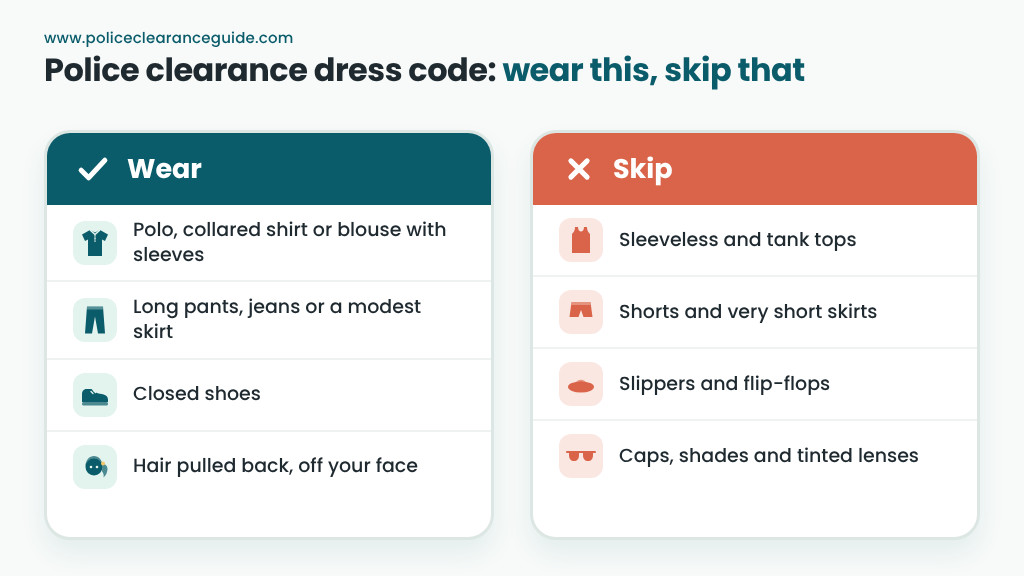
Use this table as a quick mirror check before you leave the house:
| Part of your outfit | Good choice | Better avoided |
|---|---|---|
| Top | A polo, a collared shirt or a blouse with sleeves | Sleeveless and tank tops, sheer fabric |
| Bottom | Long pants, jeans or a skirt of modest length | Shorts and very short skirts |
| Footwear | Closed shoes, such as sneakers or leather shoes | Slippers and flip-flops |
| Head | Hair pulled back, off your face | Caps, hats and hoods |
| Eyes | Clear glasses, though staff may ask you to remove them | Sunglasses and tinted lenses |
| Accessories | Small, simple pieces | Big earrings or anything covering your face |
Solid colours usually look best in a picture this small. On the other hand, busy patterns and large logos tend to pull attention away from your face.
Why the dress code for police clearance matters
It’s tempting to treat clothing as a small detail. However, three practical reasons make it worth a minute of planning.
First, a police station is a government office, and many government offices won’t let people in wearing shorts or slippers. If the guard stops you, you could miss your session, and the fee isn’t refunded.
Second, the picture stays on your clearance. Employers, schools and embassies will see it, and the paper is valid for six months, so you’ll live with that photo for a while.
Third, your moment at the camera is short. Staff work through a long line, so arriving camera-ready saves you from a rushed shot you’d rather not hand to anyone.
Picking police clearance attire for your day
Deciding what to wear for police clearance rarely means buying anything new. Find the situation that sounds most like yours:
- Heading in from work. Office clothes are ideal. In fact, a polo or a blouse is the simplest police clearance outfit there is.
- Coming straight from class. A tidy school uniform is usually accepted.
- A hot day and a long commute. Choose a light, breathable shirt with sleeves, and pack a small towel so you can freshen up before the camera.
- You cover your head for religious reasons. Ask the station ahead of time how it handles the photo.
- Slippers are all you wear day to day. Borrow a pair of closed shoes for the visit, because you don’t want footwear to cost you the slot.
Getting photo-ready under the police clearance dress code
Whatever you wear, these small habits help the picture come out clean:
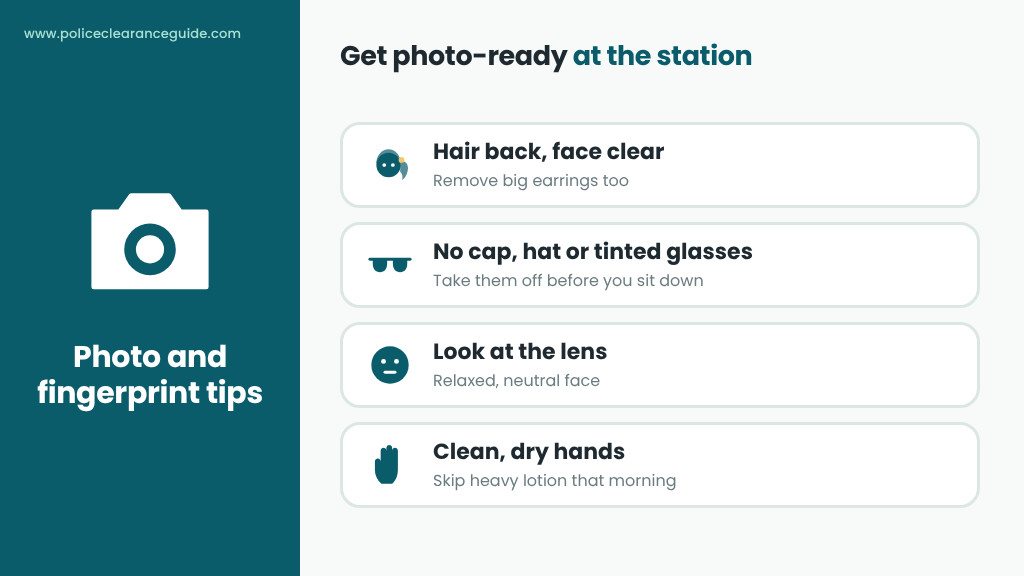
- Pull long hair back so your whole face shows.
- Take off caps, hats and tinted glasses before you sit down.
- Remove big earrings and anything else that covers part of your face.
- Sit up straight, look directly into the lens and keep a relaxed, neutral face.
- Ask to see the result, and politely ask whether a retake is possible if it’s blurry.
Light, natural makeup is fine. Similarly, a quick comb and a wipe of the face just before your turn go a long way, especially after a sweaty commute.
Fingerprint for police clearance: hands first
Staff record your fingerprints digitally, together with your photo and signature. Dry, clean fingertips scan faster, so wash your hands before your turn and go easy on lotion that morning. Also, mention any fresh cut or bandage on a finger right away, so staff can work around it.
These police clearance biometrics stay on file after your visit. That stored record is part of what lets you renew without appearance later, as long as your last in-person application was within the past three years.
Police clearance photo requirements and photo size
For a regular application, you don’t need to bring any photo at all. Staff take a live picture as part of the biometrics, so the police clearance photo size isn’t something you have to worry about.
Uploads only matter when you renew without appearance. In that case, the portal asks for a 2×2 photo plus a selfie in which you hold up a valid ID. Shoot the 2×2 against a plain white background in good daylight, and wear the same neat clothes you’d wear to the station. Our non-appearance guide walks through each upload.
If the guard stops you at the gate
Stay polite, and ask what would be acceptable. A shop nearby may sell a cheap shirt or a pair of shoes, and your session may still have time left. If you miss it anyway, ask at the desk what your options are before you go home, rather than booking again in a hurry.
Quick answers
Does every station follow one police clearance dress code?
No. Rules are set station by station, so you won’t find one list that applies everywhere. Most stations, however, expect the same proper attire for police clearance that any government office asks for: sleeves, long pants or a modest skirt, and closed shoes.
What to wear when getting police clearance on a hot day?
A light, breathable shirt with sleeves and comfortable long pants work well. Also bring water and a small towel for the wait.
Can I wear a t-shirt?
A plain, clean t-shirt with sleeves is often fine. Even so, a polo or a collared shirt is the safer bet.
Will they turn me away for wearing shorts?
They can. Since rules differ by station, don’t gamble a paid slot on your clothes.
Do I need to bring a picture?
Not for a regular application, because the station takes your photo during biometrics.
Your police clearance dress code checklist
- Top with sleeves, long pants or a modest skirt, and closed shoes
- Cap, shades and big earrings left at home or in your bag
- Long hair tied back
- Hands washed and dry, with no heavy lotion
- Valid ID, booking reference and payment receipt, kept in one pocket
- Water and a small towel if it’s hot
For the rest of the visit, see what to bring and our main police clearance guide. The PNP’s own guide for applicants lays out the official process.
