
Police Clearance Certificate: Your Copy, Its Number and Digital Versions
An HR officer asks for your police clearance certificate and its number, and you’re not sure what to send. The certificate is the one-page clearance the PNP’s national system issues, and its clearance number is what anyone uses to check it online. Most people get it on paper at the station, while some renewals come as a file you download.
Checked on 29 October 2026 against the PNP portal and its two PDF guides.
So, what is police clearance certificate in plain words? It’s the document that shows what the PNP’s records check found about you on the day it was issued. It isn’t an ID, a card or a permit.
Who needs the certificate, and why the details matter
Employers, schools, licensing offices and some banks ask for it. They want proof that a records check came back clear, from a source they trust. In turn, they look at three things: your name, the issue date and the clearance number.
That’s why the details matter so much. A name that doesn’t match your ID raises questions. An old issue date can make the paper “too old” for a strict employer. And without a readable number, nobody can verify it.
A quick word about us: we’re an independent site with no link to the PNP. We describe the certificate here; the PNP alone issues it.
How you receive your police clearance certificate
There are two ways the certificate reaches you, and the route you applied by decides which one you get.
Printed at the station. On a regular application, you appear for biometrics and the station prints the clearance after the records check. With no HIT, you leave with the paper that day. The PNP’s guides don’t mention a download for this route, so the printed copy is the one to protect.
Downloaded from your account. On a renewal without appearance, you upload your photos instead of visiting. Once the PNP approves the application, you download the clearance from your account profile and print it yourself. The portal’s Clearance Certification route for people abroad works the same way, with a Download Certificate button.
Police clearance certificate vs certification
These sound alike but differ. The national police clearance certificate is the regular document most people get. In contrast, a police clearance certification is the portal’s remote option for people who can’t come in person, such as Filipinos overseas, applicants confined to bed, people asking a court for probation or bail, and families requesting one for someone who has died. Both come from the same system, but you apply through different buttons.
What the certificate proves, and what it doesn’t
The certificate proves one thing: what the PNP’s records showed about the named person on the issue date. That’s useful, but it has limits.
- It doesn’t prove identity. Offices still check a separate government ID.
- It doesn’t cover other agencies. The NBI keeps its own records and issues its own clearance.
- It doesn’t last forever. After six months, offices treat it as expired.
- It doesn’t predict anything. It’s a snapshot of records, not a character reference.
Knowing these limits helps when an office asks for “more.” Often they simply need a second document, not a second police clearance.
Is it a police clearance ID card?
No. People search for a police clearance ID card or a police clearance card, but the national clearance is a certificate, not a card. It also doesn’t count as a valid ID. When an office asks for proof of identity, bring a real government-issued ID instead.
Likewise, the “police clearance ID number” people ask about is simply the clearance number printed on the certificate. It identifies the document, not you as a person.
Where to find your police clearance number
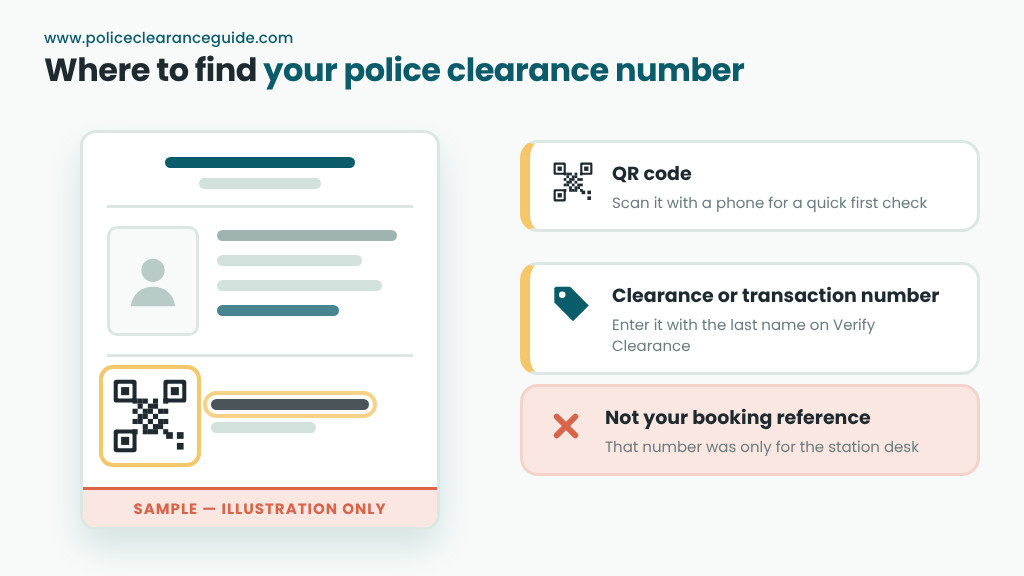
Look on the certificate itself for the number labelled as the clearance or transaction number. That’s the number the portal’s Verify Clearance page asks for, together with your last name. Don’t confuse it with your booking’s reference number, which you used at the station desk.
Keep the number handy, but share it only with people who need to verify your clearance. Our verification guide shows how an employer runs the check.
How to download and print police clearance online
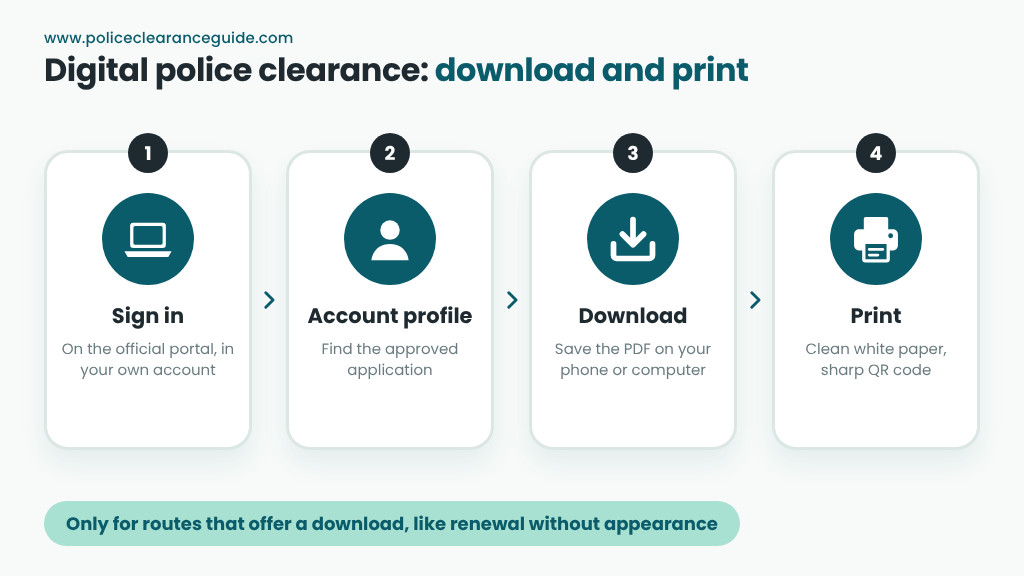
This only applies when your application route offers a download. Here’s how it goes:
- Sign in to your account on the official portal.
- Open your account profile and look for the approved application.
- Download the clearance file. Save it as a police clearance PDF on your phone or computer.
- Print it on clean white paper with a good printer, so the QR code stays sharp.
- Keep the file too, since you can print a fresh copy if the paper gets damaged.
If you don’t see a download, your clearance was probably printed at the station, which is normal for a regular application. Our renewal guide explains which route gives a digital police clearance.
Quick answers
What should I do if I lose my certificate?
Contact the station that issued it and ask about your options. If that doesn’t work, apply again from your account. Next time, scan the paper on the day you get it.
Can I laminate my police clearance certificate?
Ask the office that will receive it first. Some want to handle the original paper, so laminating it may cause trouble.
Is a digital police clearance as good as a printed one?
A downloaded clearance from an approved application is a real clearance. Still, each office decides whether it takes a printout, a file or both.
Can I use one certificate for two employers?
Often yes, as long as both accept the purpose printed on it and the issue date is recent enough for each. Ask both before you apply for a second one.
Does a new certificate replace the old one?
Yes. Every renewal gives you a new certificate with a new number and a new issue date.
In short
- The certificate is a one-page document, not an ID card.
- Its clearance number lets anyone verify it online with your last name.
- Paper comes from the station; a download comes with some renewals. For more, see our main police clearance guide.
