
Police Clearance HIT: What It Means and What Happens Next
A police clearance HIT means your details look like a record in the PNP’s database, so an officer must check the match by hand before your clearance is released. A HIT is not a verdict: very often it’s just someone with the same or a similar name. It mostly changes how long you wait, not whether you get a clearance.
Checked on 29 October 2026; process details come from the PNP’s portal and guides.
Put plainly, the HIT meaning in police clearance terms is “possible match, needs a human look.” Until an officer confirms who the record belongs to, the station holds the release.
Please note that this is an independent site with no PNP affiliation, and this page isn’t legal advice. If you know of a pending case against you, talk to a lawyer before you apply.
Who gets a HIT in police clearance checks?
Anyone can, but some people meet it more often:
- People with common names. Think of how many Filipinos share a first name and surname.
- People whose details overlap with a namesake’s. A similar birth year or hometown adds to the match.
- People with a past or pending criminal case. Their own record may show up.
For most applicants, a HIT simply means a slower day. Still, it’s worth knowing the process, because the right papers can shorten it.
How a HIT in police clearance processing works
After your photo, signature and fingerprints are captured, the system runs your details against PNP records. A clean check sends you to the release counter. A HIT sends your file to a verification officer instead.
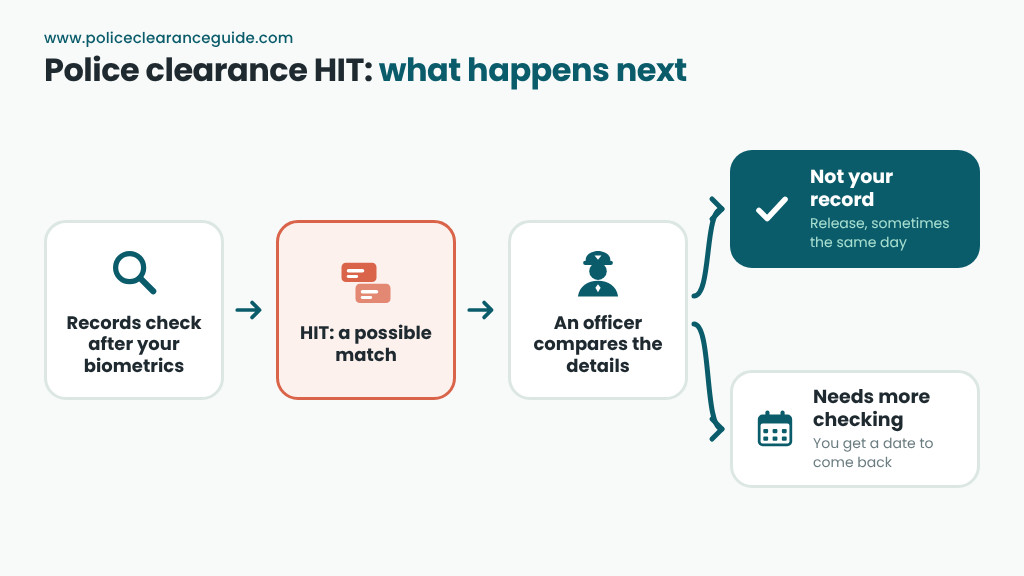
The officer then compares your full name, birth details, photo and other profile entries with the flagged record. If they clearly belong to someone else, your clearance can be released, sometimes the same day. If more checking is needed, the desk gives you a date to come back.
What changes the outcome of a police clearance with hit
Three things shape what happens next:
- Whose record it is. A namesake’s record means a delay, nothing more. Your own record is a different matter.
- The status of the case. A dismissed case and an active one lead to very different conversations.
- How complete your details are. A full middle name, the right suffix and accurate birth details help the officer rule out a namesake faster.
What to do if your police clearance shows a HIT
Stay calm, and work through these steps:
- Ask for the return date and write it down. There’s no online tracking for a HIT, so the desk is your source.
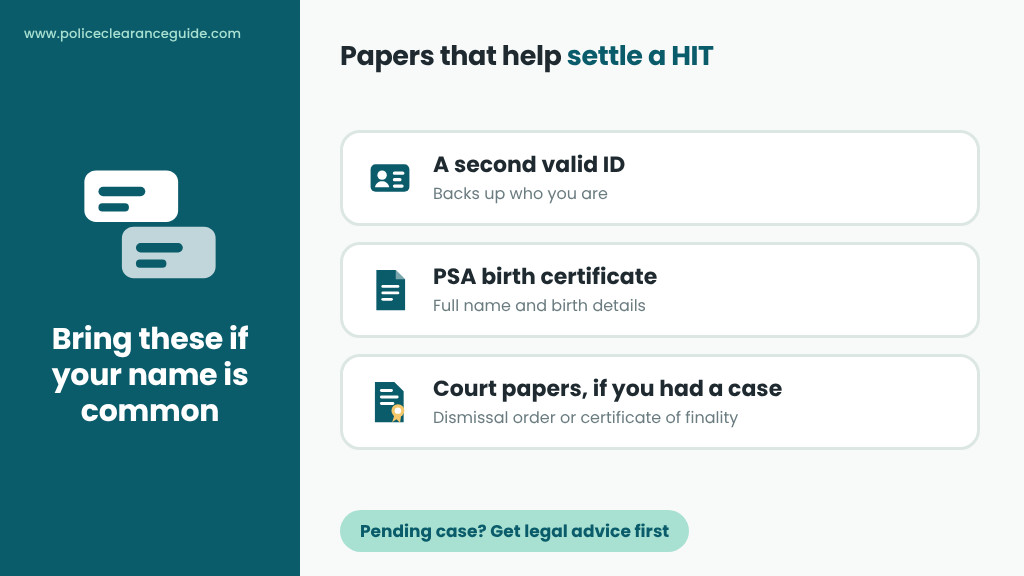
- Bring a second ID. A PSA birth certificate also helps prove who you are.
- If you had a case that was dismissed or settled, bring court papers that show it, such as a certified copy of the dismissal order or a certificate of finality.
- If you have a pending case, get legal advice first. If a record turns out to be an active warrant, the police must act on it.
- Check your profile. Fix missing middle names or suffixes before your next application.
Our page on release times shows how a HIT fits into the overall timeline.
What a HIT doesn’t mean
A HIT can feel alarming, so it helps to know its limits. It doesn’t mean anyone has accused you of anything. It doesn’t mean your clearance will list a record that belongs to a namesake. And it doesn’t stop you from applying again in the future. In most cases, it simply means an officer needs a closer look before the release.
How to lower the odds of a long HIT check
The database is out of your hands. Your own profile isn’t, and a tidy one is easier to tell apart:
- Use your complete name. Add your full middle name and any suffix, exactly as your ID shows them.
- Get your birth details right. A wrong birth date or birthplace makes a namesake harder to rule out.
- Keep your spelling consistent. Your IDs, profile and documents should all agree.
- Carry extra proof. If your name is common, bring a second ID and your PSA birth certificate.
- Book early. A head start absorbs a delay without hurting your deadline.
Does a civil case or an unpaid loan cause a HIT?
The police clearance records check looks at criminal records. A purely civil matter, such as an unpaid loan or a small claims case, isn’t a criminal case by itself. So, can I get police clearance if I have unpaid loan? Usually, yes. A debt only matters here if it led to a criminal complaint, like an estafa or bouncing-check case, that reached the courts.
Does a blotter appear in a police clearance?
A blotter entry records a report made at a station. On its own, it isn’t a criminal case. However, if the report led to a complaint that was filed in court, that case could show up in a records check.
Police clearance with record: what then?
If the match really is your own record, the outcome depends on the case and its status, and the station will explain what it can release. Because every case differs, a lawyer is the right person to advise you. You can also ask the court that handled the case for documents showing its current status.
Quick answers
| Question | Short answer |
|---|---|
| Is a HIT the same as having a record? | No. It’s a possible match that an officer has to confirm, and most turn out to be namesakes. |
| Is a police clearance hit check done online? | No. A verification officer checks it at the station. |
| How long does a HIT delay my clearance? | From the same day to several working days, depending on the match. |
| Pwede ba kumuha ng police clearance kahit may kaso? | It depends on the case and its status. Get legal advice if you have a pending case. |
| Does civil case appear in police clearance checks? | A civil case on its own isn’t a criminal record, so it usually doesn’t. |
Your next step
Before your appointment, make sure your profile has your full middle name and any suffix, because complete details speed up a namesake check. Then read our main police clearance guide for the rest of the process. The PNP’s application guide covers the official steps.
