Local Police Clearance: What It Is and When It’s Enough
A permit officer at your municipal hall asks for a police clearance, and you wonder whether the one from your town’s station will do. A local police clearance comes from your city or municipal police station and mainly covers local records, so it’s enough only when the office asking for it says so. For jobs and anything outside your town, the national clearance is the safer pick.
Checked on 29 October 2026. National rules come from the PNP portal; local rules vary by town.
This guide is written independently, with no link to the PNP or any local government. Local rules differ from town to town, so the station’s own word always comes first.
Local police clearance vs national police clearance
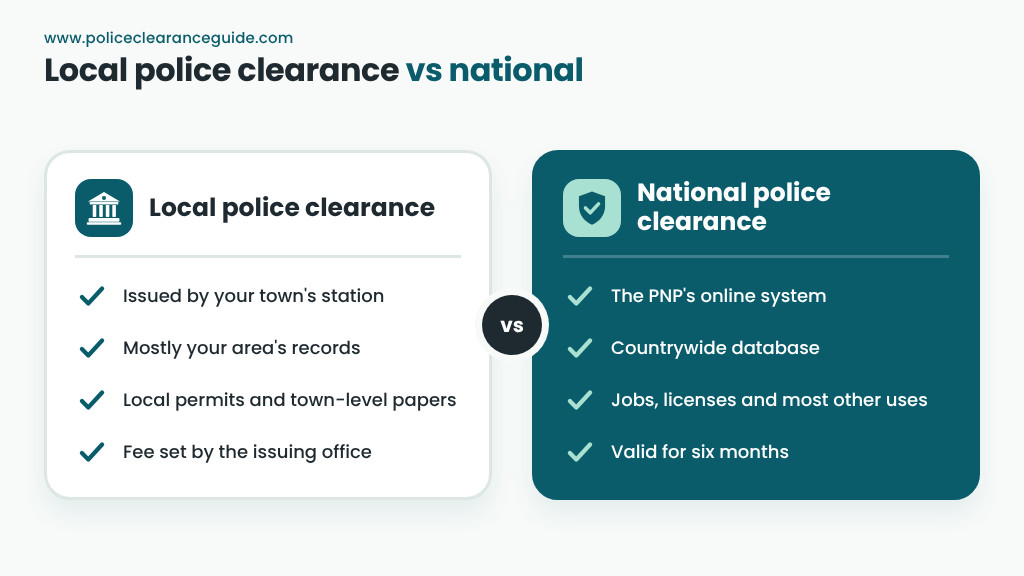
Both papers come from the police, but they’re built differently:
| Local police clearance | National police clearance | |
|---|---|---|
| Issued by | Your city or municipal police station | The PNP’s national system |
| How you apply | In person, by the station’s own process | Online booking, then one station visit |
| Records it reflects | Mostly your area’s records | The PNP’s countrywide database |
| Best for | Local permits and town-level papers | Jobs, licenses and most other uses |
| Typical documents | Valid ID, barangay clearance, cedula | Valid ID, reference number, payment proof |
| Fee and validity | Set by the issuing office | ₱150 plus a channel charge; six months |
Which one fits your situation?
Pick the scenario closest to yours:
- An employer asked for a “police clearance.” Get the national one. Employers rarely accept a local clearance, since it doesn’t cover the whole country.
- Your town hall needs one for a local permit. Ask the office directly. If they accept a local clearance, it may be the quicker option.
- A paper says “municipal police clearance” or “city police clearance.” That points to a local one, but confirm before you go.
- Someone asks for a “provincial police clearance.” Today, the national clearance covers every province. Offices that once asked for a provincial paper usually accept the national one, but check first.
- You’re not sure. Choose national. It works for nearly every purpose a local paper does, and many more.
How to get local police clearance
Each station runs its own process, so call ahead. In most towns, it goes roughly like this:
- Phone the municipal police station (MPS) or city station that covers your address.
- Ask two questions: do they still issue local clearances, and what’s on their list?
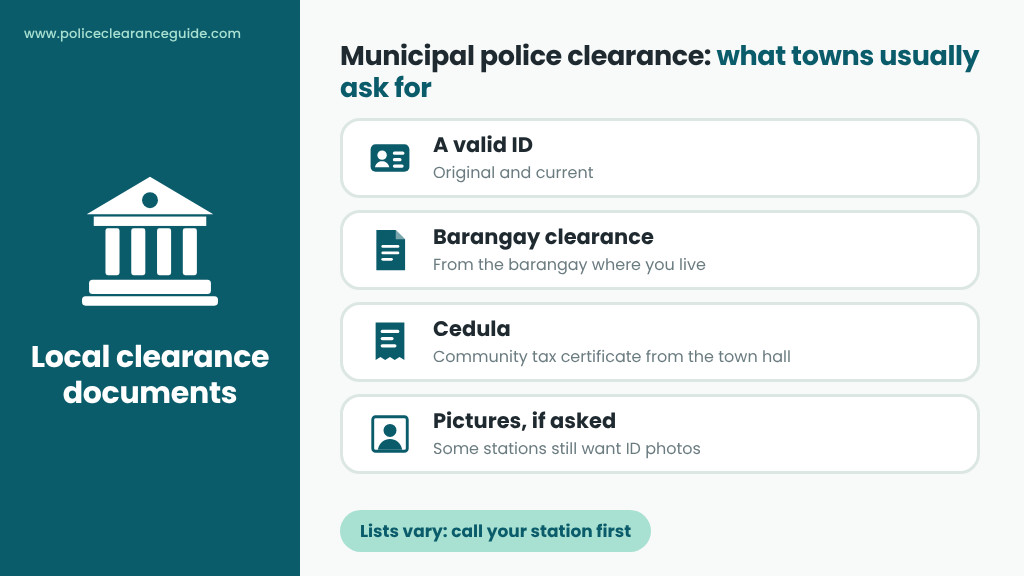
- Collect what they name, commonly a barangay clearance plus a cedula from your town hall.
- Visit during office hours with your valid ID and any pictures they asked for.
- Complete their paperwork and settle the local fee, which some towns collect at a cashier.
- Wait for the release. Many stations hand it over within the day.
The local police clearance requirements vary, so treat the list above as a guide only. An “MPS police clearance” simply means a local clearance from a municipal police station.
Going national instead
If the office wants the national paper, the work moves to your phone. You create an account on pnpclearance.ph, fill in your profile, reserve a slot and pay online. The station visit comes last and takes only a few minutes of capture. In most cases, the clearance is printed before you leave. Our full application steps break each stage down.
Why local and national results can differ
A local check leans on the records your town’s station keeps. So a case filed in another province may never show up there. The national check, on the other hand, runs against one countrywide database. That’s the main reason employers prefer the national clearance: it answers a bigger question.
For the same reason, a clean local clearance doesn’t guarantee a clean national one. If you have any doubt, apply for the national clearance early, so a possible HIT doesn’t collide with a deadline.
Getting both: does it ever make sense?
Rarely, but it happens. A town office might insist on its own local paper for a permit, while your employer wants the national one for the job. In that case, you’ll need both, with two fees and two visits. Plan them in the same week if you can, and keep each office’s exact requirement in writing.
Is national police clearance the same as police clearance?
Usually, no. Most people who say “police clearance” today mean the national one. The difference between national police clearance and police clearance only matters when an office specifically wants a local paper. So the question of national police clearance vs police clearance often has a simple answer: they’re the same document.
Can I get a local police clearance online?
The PNP’s portal issues the national clearance only. If your town offers local clearances through its own online channel, the station will tell you. Otherwise, a local police clearance online search will usually lead you back to the national system, and that’s the one most offices want anyway.
What are the types of police clearance?
There are four papers people mix up:
- National police clearance: the standard clearance from the PNP’s online system.
- Local police clearance: a town-level clearance from a city or municipal station.
- Clearance Certification: the portal’s remote route for Filipinos abroad and others who can’t appear.
- NBI clearance: a different document from a different agency, the National Bureau of Investigation.
Knowing the types of police clearance saves you from paying for the wrong one. Our page on walk-in rules explains which ones you can get without a booking.
Is a local police clearance certificate valid anywhere?
Its reach depends on the office that receives it. Some accept it for local matters only, while others don’t accept it at all. So never assume; a quick call saves you a wasted fee. Meanwhile, the national clearance is accepted across the country for six months.
Do this now
- Ask the requesting office which clearance it wants, in writing if possible.
- If it’s local, phone your station for its list and hours.
- If it’s national or unclear, book online today.
For everything else about the national process, head to our main police clearance guide.
